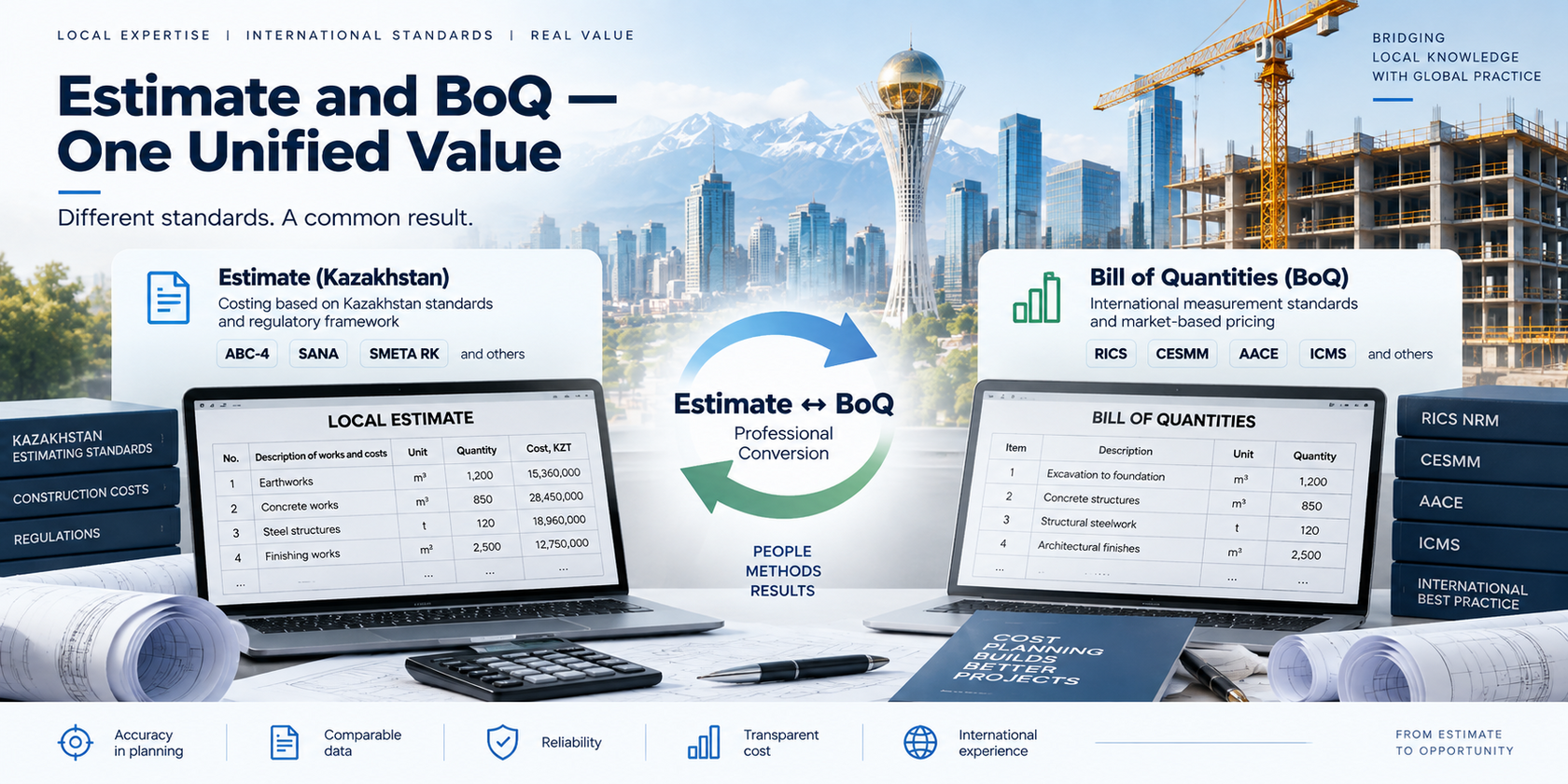
We are often asked to convert an estimate into a Bill of Quantities (BoQ). Or, conversely, to convert an existing BoQ into an estimate prepared in accordance with the standards of the Republic of Kazakhstan.
At first glance, the task may seem purely technical: there is a list of works, quantities, and costs - all that remains is to transfer the data from one format to another.
In practice, it is significantly more complex.
An estimate prepared under Kazakhstan standards and an international Bill of Quantities are documents with different structures and underlying logic. Therefore, simply copying line items, renaming positions, or transferring data from one software package into Excel does not produce a correct result.
This type of work requires a simultaneous understanding of the structure of Kazakhstan estimates, the principles of BoQ preparation, local cost-estimating rules, international methods of measurement, and cost estimating approaches.
Most errors arise precisely at the intersection of these systems.
What Is an Estimate Under Kazakhstan Standards?
In Kazakhstan, construction costs for regulated projects are determined within the applicable estimating and regulatory framework.
The calculation is based on resource consumption norms, the cost of materials, operation of construction machinery, labor resources, transportation, and other applicable cost components.
Such calculations are performed using specialized estimating software based on the regulatory framework of the Republic of Kazakhstan, including:
ABC-4 / ABC-KZ, SANA, SMETA RK, and other specialized solutions.
Therefore, a line item in a Kazakhstan estimate is not simply:
work × quantity × price.
Behind it may be a resource-based cost model comprising labor, materials, equipment, transportation, and other components.
This internal structure is critically important when the data needs to be converted into an international format.
What Is a Bill of Quantities?
A Bill of Quantities (BoQ) is a structured list of measured and described quantities of work used for tendering, pricing, contractual valuation, and cost control.
In international practice, BoQs may be prepared in accordance with different systems and methodologies.
For example, RICS NRM 2 establishes detailed rules for the measurement and description of building works and provides guidance on the structure and format of Bills of Quantities. RICS identifies NRM 2 as a framework for detailed measurement when preparing BoQs and other quantity-based pricing documents.
For civil engineering projects, CESMM4 - Civil Engineering Standard Method of Measurement is widely used. The Institution of Civil Engineers defines its purpose as establishing procedures for preparing and pricing Bills of Quantities, as well as rules for expressing and measuring quantities of work.
Depending on the project, different methodologies may apply:
These documents serve different purposes and should not be treated as interchangeable standards.
The Key Difference: International Standards Are Not Equivalent to Kazakhstan Schedule of Rates
This is one of the most important distinctions.
When a client says:
“Prepare the BoQ in accordance with RICS”
this does not mean that there is a RICS schedule containing a prescribed cost per cubic metre of concrete, tonne of reinforcement, or equipment installation item.
RICS NRM primarily establishes rules for measurement, description, and cost structuring. It does not prescribe a government-set price for construction resources.
Likewise, CESMM defines a measurement methodology for civil engineering works.
As a result, an international cost model is often developed as follows:
Scope / Drawings / BIM
↓
Quantity Take-Off
↓
Method of Measurement
↓
BoQ
↓
Unit Rate Build-Up
↓
Tender / Project Cost
The price may then be developed based on:
Therefore, a BoQ is not simply “an estimate in English.”
Where AACE Is Used
For major industrial, infrastructure, and EPC projects, AACE International plays an important role.
AACE approaches project cost from the perspective of Cost Engineering.
For example, Recommended Practice 17R-97 Cost Estimate Classification System establishes general principles for classifying project cost estimates based on the maturity of scope definition. AACE uses estimate classes ranging from Class 5 to Class 1.
In addition to the general methodology, there are industry-specific Recommended Practices for:
AACE also places particular emphasis on the Basis of Estimate (BoE) - a document that explains the input data, assumptions, and methodology used to develop the estimate.
Accordingly, a professional international cost estimate is more than a table of quantities and prices.
It is also necessary to understand where the price comes from and what assumptions underpin it.
What Is ICMS?
Another level is the International Cost Management Standard (ICMS).
ICMS is used to standardize the presentation, grouping, and classification of project costs. The current third edition also links cost reporting with carbon emissions.
This is particularly important for international investors, EPC companies, and groups implementing projects across multiple countries.
One project may be costed under Kazakhstan's national system, another under a British methodology, and another under an internal corporate framework.
To compare such projects, the data must be brought into a consistent and comparable structure.
This is why professional cost management increasingly involves not one standard, but mapping between different classification and pricing systems.
Why an Estimate Cannot Simply Be Converted into a BoQ
Suppose a Kazakhstan estimate contains a particular work item.
That item may internally include:
Work → labor + materials + equipment + other resources
When converting it into a BoQ, it is necessary to determine:
Therefore, one line item in an estimate does not necessarily become one line item in a BoQ.
It may need to be split into several positions.
Conversely, one composite BoQ item may require several Kazakhstan estimating norms and a substantial number of resources when converted into a Kazakhstan estimate.
The Reverse Process Is Even More Complex: BoQ → Kazakhstan Estimate
When converting an international BoQ into an estimate under the standards of the Republic of Kazakhstan, it is not enough to simply transfer quantities and descriptions.
It is necessary to determine the composition of each item, understand which works and resources are included in the rate, map them to the applicable estimating norms, and build the corresponding resource structure.
Differences in work classification, units of measurement, rate composition, and pricing rules must also be taken into account.
We Work Between Two Systems
Our task is not to mechanically convert one table into another.
We can work with the project simultaneously at two levels.
Kazakhstan System
↕ Cost Mapping / Reconciliation
International System
This approach makes it possible to produce a document that is understandable to the Kazakhstan client, international contractor, investor, EPC company, and cost consultant.
When This Service Is Particularly Important
Professional Estimate ↔ BoQ conversion is especially important when:
Estimate ↔ BoQ Is Not a Format Conversion. It Is a Translation of Cost Methodology
A high-quality result requires knowledge of two professional languages.
On one side is Kazakhstan's regulatory cost-estimating system and software tools such as ABC-4 / ABC-KZ, SANA, SMETA RK, and others.
On the other side are international approaches such as RICS NRM, CESMM, AACE, and ICMS, together with the principles of Quantity Surveying, Cost Engineering, and market-based pricing.
For this reason, we treat the task not as transferring rows from one table to another, but as Cost Mapping:
Kazakhstan Estimate → resource analysis → classification → mapping → BoQ → Unit Rate Build-Up → Cost Reconciliation
Or in the reverse direction:
BoQ → analysis of scope and inclusions → rate decomposition → mapping to Kazakhstan norms → resource model → estimate
BoQ Preparation and Conversion Services
We provide:
The result is not simply a new file, but a transparent and auditable cost model in which the origin of quantities, rates, and the final project cost can be traced.
For an international project, this level of transparency enables the client, designer, and contractor to speak the same language when discussing cost.
At first glance, the task may seem purely technical: there is a list of works, quantities, and costs - all that remains is to transfer the data from one format to another.
In practice, it is significantly more complex.
An estimate prepared under Kazakhstan standards and an international Bill of Quantities are documents with different structures and underlying logic. Therefore, simply copying line items, renaming positions, or transferring data from one software package into Excel does not produce a correct result.
This type of work requires a simultaneous understanding of the structure of Kazakhstan estimates, the principles of BoQ preparation, local cost-estimating rules, international methods of measurement, and cost estimating approaches.
Most errors arise precisely at the intersection of these systems.
What Is an Estimate Under Kazakhstan Standards?
In Kazakhstan, construction costs for regulated projects are determined within the applicable estimating and regulatory framework.
The calculation is based on resource consumption norms, the cost of materials, operation of construction machinery, labor resources, transportation, and other applicable cost components.
Such calculations are performed using specialized estimating software based on the regulatory framework of the Republic of Kazakhstan, including:
ABC-4 / ABC-KZ, SANA, SMETA RK, and other specialized solutions.
Therefore, a line item in a Kazakhstan estimate is not simply:
work × quantity × price.
Behind it may be a resource-based cost model comprising labor, materials, equipment, transportation, and other components.
This internal structure is critically important when the data needs to be converted into an international format.
What Is a Bill of Quantities?
A Bill of Quantities (BoQ) is a structured list of measured and described quantities of work used for tendering, pricing, contractual valuation, and cost control.
In international practice, BoQs may be prepared in accordance with different systems and methodologies.
For example, RICS NRM 2 establishes detailed rules for the measurement and description of building works and provides guidance on the structure and format of Bills of Quantities. RICS identifies NRM 2 as a framework for detailed measurement when preparing BoQs and other quantity-based pricing documents.
For civil engineering projects, CESMM4 - Civil Engineering Standard Method of Measurement is widely used. The Institution of Civil Engineers defines its purpose as establishing procedures for preparing and pricing Bills of Quantities, as well as rules for expressing and measuring quantities of work.
Depending on the project, different methodologies may apply:
- Buildings - RICS NRM
- Civil & Infrastructure - CESMM
- Cost Engineering / EPC - AACE Recommended Practices
- International Cost Reporting & Benchmarking - ICMS
These documents serve different purposes and should not be treated as interchangeable standards.
The Key Difference: International Standards Are Not Equivalent to Kazakhstan Schedule of Rates
This is one of the most important distinctions.
When a client says:
“Prepare the BoQ in accordance with RICS”
this does not mean that there is a RICS schedule containing a prescribed cost per cubic metre of concrete, tonne of reinforcement, or equipment installation item.
RICS NRM primarily establishes rules for measurement, description, and cost structuring. It does not prescribe a government-set price for construction resources.
Likewise, CESMM defines a measurement methodology for civil engineering works.
As a result, an international cost model is often developed as follows:
Scope / Drawings / BIM
↓
Quantity Take-Off
↓
Method of Measurement
↓
BoQ
↓
Unit Rate Build-Up
↓
Tender / Project Cost
The price may then be developed based on:
- supplier quotations;
- subcontractor quotations;
- labor costs;
- labor productivity;
- equipment operating or rental costs;
- historical data from comparable projects;
- corporate cost databases;
- market benchmarking;
- logistics;
- overheads;
- risk allowances;
- profit;
- escalation.
Therefore, a BoQ is not simply “an estimate in English.”
Where AACE Is Used
For major industrial, infrastructure, and EPC projects, AACE International plays an important role.
AACE approaches project cost from the perspective of Cost Engineering.
For example, Recommended Practice 17R-97 Cost Estimate Classification System establishes general principles for classifying project cost estimates based on the maturity of scope definition. AACE uses estimate classes ranging from Class 5 to Class 1.
In addition to the general methodology, there are industry-specific Recommended Practices for:
- process industries;
- mining;
- buildings;
- road & rail;
- power transmission;
- pipelines;
- other project types.
AACE also places particular emphasis on the Basis of Estimate (BoE) - a document that explains the input data, assumptions, and methodology used to develop the estimate.
Accordingly, a professional international cost estimate is more than a table of quantities and prices.
It is also necessary to understand where the price comes from and what assumptions underpin it.
What Is ICMS?
Another level is the International Cost Management Standard (ICMS).
ICMS is used to standardize the presentation, grouping, and classification of project costs. The current third edition also links cost reporting with carbon emissions.
This is particularly important for international investors, EPC companies, and groups implementing projects across multiple countries.
One project may be costed under Kazakhstan's national system, another under a British methodology, and another under an internal corporate framework.
To compare such projects, the data must be brought into a consistent and comparable structure.
This is why professional cost management increasingly involves not one standard, but mapping between different classification and pricing systems.
Why an Estimate Cannot Simply Be Converted into a BoQ
Suppose a Kazakhstan estimate contains a particular work item.
That item may internally include:
Work → labor + materials + equipment + other resources
When converting it into a BoQ, it is necessary to determine:
- What physical quantity should be measured?
- How should the work be classified under the selected Method of Measurement?
- Which resources are included in the Unit Rate?
- Which items should be separated?
- What is classified as direct cost?
- What is classified as preliminaries?
- Where are overheads included?
- How is the contractor's profit accounted for?
- Where is risk / contingency included?
- How should escalation be treated?
- What is included in the price and what should be excluded?
- Will restructuring create any double counting?
Therefore, one line item in an estimate does not necessarily become one line item in a BoQ.
It may need to be split into several positions.
Conversely, one composite BoQ item may require several Kazakhstan estimating norms and a substantial number of resources when converted into a Kazakhstan estimate.
The Reverse Process Is Even More Complex: BoQ → Kazakhstan Estimate
When converting an international BoQ into an estimate under the standards of the Republic of Kazakhstan, it is not enough to simply transfer quantities and descriptions.
It is necessary to determine the composition of each item, understand which works and resources are included in the rate, map them to the applicable estimating norms, and build the corresponding resource structure.
Differences in work classification, units of measurement, rate composition, and pricing rules must also be taken into account.
We Work Between Two Systems
Our task is not to mechanically convert one table into another.
We can work with the project simultaneously at two levels.
Kazakhstan System
- ABC-4 / ABC-KZ;
- SANA;
- SMETA RK;
- regulatory framework of the Republic of Kazakhstan;
- resource-based cost structure.
↕ Cost Mapping / Reconciliation
International System
- RICS NRM;
- CESMM;
- AACE Recommended Practices;
- ICMS;
- BoQ;
- Quantity Take-Off;
- Unit Rate Build-Up;
- Basis of Estimate.
This approach makes it possible to produce a document that is understandable to the Kazakhstan client, international contractor, investor, EPC company, and cost consultant.
When This Service Is Particularly Important
Professional Estimate ↔ BoQ conversion is especially important when:
- an international client receives design documentation developed in accordance with the standards of the Republic of Kazakhstan;
- a foreign EPC contractor needs to prepare a commercial proposal for a Kazakhstan project;
- the contractor's Tender Price needs to be compared with the estimated cost;
- a BoQ prepared by a foreign designer must be adapted to Kazakhstan requirements;
- the Unit Rates of an international contractor need to be reviewed;
- Cost Reconciliation is required between several project participants;
- a Basis of Estimate needs to be prepared;
- costs across several projects need to be brought into a common structure for benchmarking;
- it is necessary to verify what is included in the contractor's rate and whether there is any double counting;
- an investor needs to compare the regulated and market-based cost of a project.
Estimate ↔ BoQ Is Not a Format Conversion. It Is a Translation of Cost Methodology
A high-quality result requires knowledge of two professional languages.
On one side is Kazakhstan's regulatory cost-estimating system and software tools such as ABC-4 / ABC-KZ, SANA, SMETA RK, and others.
On the other side are international approaches such as RICS NRM, CESMM, AACE, and ICMS, together with the principles of Quantity Surveying, Cost Engineering, and market-based pricing.
For this reason, we treat the task not as transferring rows from one table to another, but as Cost Mapping:
Kazakhstan Estimate → resource analysis → classification → mapping → BoQ → Unit Rate Build-Up → Cost Reconciliation
Or in the reverse direction:
BoQ → analysis of scope and inclusions → rate decomposition → mapping to Kazakhstan norms → resource model → estimate
BoQ Preparation and Conversion Services
We provide:
- Kazakhstan Estimate → International BoQ
- International BoQ → Kazakhstan Estimate
- Quantity Take-Off and BoQ preparation
- Unit Rate Build-Up
- Review and decomposition of contractor rates
- Cost Reconciliation
- Cost Benchmarking
- Basis of Estimate
- Comparison of costs under Kazakhstan and international methodologies
The result is not simply a new file, but a transparent and auditable cost model in which the origin of quantities, rates, and the final project cost can be traced.
For an international project, this level of transparency enables the client, designer, and contractor to speak the same language when discussing cost.